Week 8: Greedy reasoning and mixed assessment
Decisions from a single scan
When each position allows a different travel distance, determine reachability and the fewest moves. On a circular route, find a starting point that never runs out of fuel.
Solving these tasks without storing every choice requires a reason that discarded candidates cannot be needed. Reachable ranges and prefix sums provide that reason.
Learning outcomes
Sessions 15 and 16: Reachable ranges, candidate elimination, counterexamples, and mixed assessment
- Check contracts and boundary conditions.
- Trace state and implement in Python.
- Explain correctness, time, auxiliary space, and output space.
Why discarded candidates stay unnecessary
A greedy algorithm eliminates alternatives before storing all choices. It needs a reason why a discarded choice cannot later improve the answer. Merely choosing a large value does not establish that reason.
| Problem | Summary retained | Reason for elimination |
|---|---|---|
| Reachability | Interval 0..farthest | Earlier positions cover a continuous prefix |
| Minimum jumps | Current end, next farthest | Inspect every position with fewer jumps first |
| Fuel circuit | Candidate start and tank | Every start inside a failed segment also fails |
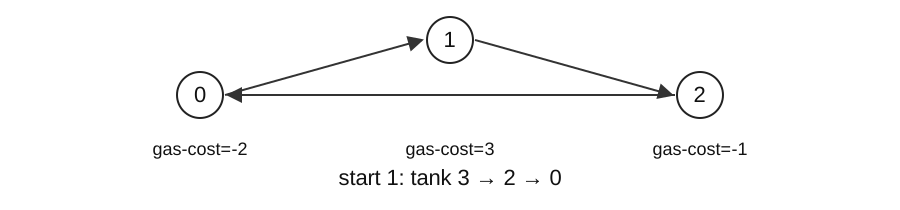
The pictured total balance is zero. Start 0 fails immediately, whereas start 1 completes the circuit with balances 3,2,0. Testing total fuel and selecting a starting point serve different roles.
55 · Idea and execution trace
LeetCode 55: Jump Game · Medium
Decide whether maximum forward jump lengths permit reaching the last index.
Each value is a maximum jump length, not a mandatory jump. Reachable intervals therefore form a continuous prefix starting at zero. Keep only its farthest endpoint to decide whether the current index can be visited.
nums=[2,0,1,0]. Test reachability using the old farthest before updating it.
| index | step | Old farthest | New farthest |
|---|---|---|---|
| 0 | 2 | 0 | max(0,0+2)=2 |
| 1 | 0 | 2 | max(2,1+0)=2 |
| 2 | 1 | 2 | max(2,2+1)=3 |
| 3 | 0 | 3 | max(3,3+0)=3 |
Index 3 is reachable, so return True.
55 · Turning the idea into code
def can_jump(nums):
    farthest = 0
    for index, step in enumerate(nums):
        if index > farthest:
            return False
        farthest = max(farthest, index + step)
    return True
Extending the range using an unreachable position would invent a nonexistent path. Test index > farthest before updating the range.
For [1,0,2], farthest remains 1 when index 2 is reached, so return False. A large step at an unreachable cell cannot help.
55 · Why it works; time and memory
Reachable positions form the interval 0..farthest. Allowed jumps include every shorter distance, preserving an interval; an index beyond it cannot be crossed.
Read n elements once, using only comparison, addition, and max at each step. Paths are not enumerated, so time is O(n); early failure may shorten a run.
Instead of storing every reachable position in a set, retain one endpoint of a continuous interval. A fixed number of variables gives O(1) auxiliary space. Allowing all smaller jump lengths is what makes this interval summary valid.
45 · Idea and execution trace
LeetCode 45: Jump Game II · Medium
Return the minimum jumps needed to reach the last index.
Treat all positions reachable with one more jump as a layer. Inspect the whole current layer before fixing the next farthest endpoint. The first layer covering the destination gives the minimum jump count; no single longest jump is chosen in advance.
nums=[2,3,0,1,0]. end marks the layer boundary for the current jump count.
| index | Updated farthest | Old end | Updated jumps,end |
|---|---|---|---|
| 0 | 2 | 0 | 1,2 |
| 1 | 4 | 2 | 1,2 |
| 2 | 4 | 2 | 2,4 |
| 3 | 4 | 4 | 2,4 |
Route 0 → 1 → 4 needs two jumps; committing to 0 → 2 gets stuck.
45 · Turning the idea into code
def min_jumps(nums):
    end = farthest = jumps = 0
    for index in range(len(nums) - 1):
        farthest = max(farthest, index + nums[index])
        if index == end:
            jumps += 1
            end = farthest
    return jumps
First include the current position’s reach in farthest. When index == end, the current layer is fully inspected: increase jumps and move end to farthest.
Use range(len(nums)-1) because no jump is needed from the destination. The problem guarantees reachability; without that guarantee, check can_jump first.
45 · Why it works; time and memory
Scan every reachable position in the current level before fixing the next frontier. These are BFS levels in an implicit unweighted graph, so the jump count is minimal.
Explicitly constructing all possible jump edges could create many edges per position. This implementation summarizes each continuous layer with endpoints and scans only n-1 indices, taking O(n) time. Expanding farthest never restarts earlier scans.
Only end, farthest, jumps, and loop variables are stored, giving O(1) auxiliary space. It uses BFS layers conceptually without building a queue. Length one executes zero iterations and returns zero jumps.
In the example, layer 0 is {0}, the positions newly reached with one jump are {1,2}, and the next layer is {3,4}. Even after index=1 discovers endpoint 4, the scan finishes the current layer through index=2 before committing jumps=2. end is the last index to examine in a layer, not a chosen landing position.
134 · Idea and execution trace
LeetCode 134: Gas Station · Medium
Return a start completing a circular route from an empty tank, or -1.
When a segment first runs out of fuel, every intermediate starting point also fails by that endpoint. The original start accumulated a nonnegative balance before reaching each intermediate point; starting there with no balance cannot improve the failed suffix. Discard the whole failed segment at once.
gas=[1,4,2], cost=[3,1,3]. total is the global balance; tank is the current candidate’s balance.
| index | gas-cost | total | tank after failure check | start |
|---|---|---|---|---|
| 0 | -2 | -2 | 0 (reset) | 1 |
| 1 | +3 | 1 | 3 | 1 |
| 2 | -1 | 0 | 2 | 1 |
Starting at 1, balances along 1 → 2 → 0 are 3 → 2 → 0.
134 · Turning the idea into code
def gas_start(gas, cost):
    total = tank = start = 0
    for index, (supply, use) in enumerate(zip(gas, cost)):
        total += supply - use
        tank += supply - use
        if tank < 0:
            start, tank = index + 1, 0
    return start if total >= 0 else -1
Do not reset total on failure: it measures whether total supply covers total consumption. Reset only tank and move start past the failure point.
A negative total makes every start impossible. Otherwise the final candidate follows a minimum prefix balance and completes the circuit. Tank capacity is unlimited and gas/cost lengths agree.
134 · Why it works; time and memory
At the first failure over s..i, each earlier prefix s..j-1 is nonnegative. Removing such a prefix leaves j..i negative too, eliminating all intermediate starts. If total is nonnegative, the final candidate also has enough surplus to wrap through the eliminated prefixes.
Trying n steps independently from each start would cost O(). Eliminating every start in a failed segment lets index advance without restarting, so there are n constant-cost updates: O(n) time.
zip reads one pair at a time without constructing a difference array. A fixed number of counters gives O(1) auxiliary space. Check both the size of the returned index and the absence of growing intermediate storage.
Removing a failed segment and wrapping around
For differences [2,−1,−3,3], starting at 0 gives fuel 2→1→−2. The first failure at 2 eliminates starts 0,1,2. Start 1 would also fail with −1−3=−4; start 2 fails with −3.
Prefix sum P[k] is the sum of the first k differences. Here P=[0,2,1,−2,1] has its minimum at 3, which is also the algorithm’s new start.
| Station visited from start 3 | Calculation | Fuel |
|---|---|---|
| 3 | 3 | 3 |
| 0 | 3+2 | 5 |
| 1 | 3+2−1 | 4 |
| 2 | 3+2−1−3 | 1 |
In general, fuel after a minimum-prefix position s is P[k]−P[s]≥0. After wrapping, fuel is the full sum P[n] plus P[k]−P[s]. If the full sum is nonnegative, this is also nonnegative, proving that the final candidate completes the wrapped portion too.
200 · Idea and execution trace
LeetCode 200: Number of Islands · Medium
Count land components connected horizontally or vertically in a character grid.
Starting from one land cell and following all four-directional connections reaches its whole island. Start a traversal and increase the count only at unvisited land, preventing duplicate counting. Diagonals do not connect cells.
Grid: [["1","1","0"],["0","1","0"],["1","0","1"]]. Coordinates start at zero; stack top is on the right.
| Action | stack | Newly added to seen | count |
|---|---|---|---|
| Start (0,0) | [(0,0)] | (0,0) | 1 |
| Pop (0,0) | [(0,1)] | (0,1) | 1 |
| Pop (0,1) | [(1,1)] | (1,1) | 1 |
| Pop (1,1) | [] | None | 1 |
| Traverse (2,0), (2,2) separately | [] | (2,0), (2,2) | 3 |
200 · Turning the idea into code
def islands(grid):
    rows, cols = len(grid), len(grid[0])
    seen, count = set(), 0
    for row in range(rows):
        for col in range(cols):
            if grid[row][col] != "1" or (row, col) in seen:
                continue
            count += 1
            stack = [(row, col)]
            seen.add((row, col))
            while stack:
                r, c = stack.pop()
                for nr, nc in ((r-1,c),(r+1,c),(r,c-1),(r,c+1)):
                    if (0 <= nr < rows and 0 <= nc < cols
                            and grid[nr][nc] == "1" and (nr,nc) not in seen):
                        seen.add((nr,nc))
                        stack.append((nr,nc))
    return count
The outer loops locate traversal starts; the inner while finishes one connected island. Mark a cell in seen just before pushing it, preventing another neighbor from pushing it again.
Cells contain strings “1” and “0”. Check coordinate bounds before reading a cell. The input grid remains unchanged.
200 · Why it works; time and memory
A traversal reaches exactly its starting component. Marked components cannot restart; the number of starts equals the component count.
The outer scan reads R·C cells. Each land cell is pushed and popped once because of seen, and each pop checks four neighbors. Four is independent of input size, giving expected O(RC) time under expected hash-set costs. The inner traversal is not restarted fully for every cell.
Both seen and the pending stack can hold up to RC coordinates, so auxiliary space is O(RC). Marking the grid itself could replace seen, but would mutate the input and would not eliminate stack storage.
Checkpoint questions
- Is the last index reachable in
[2,0,0,1]? - Find the minimum jumps for
[2,3,0,1,0]. - Find a start for gas=
[1,4,2], cost=[3,1,3]. - How many jumps are needed for a reachable length-one array?
Exercises and sources
LeetCode · 55, 45, 134, 200 · Worked solutions · Python ZIP
python demo_15.py
python demo_16.py
python verify.py
After implementing the student file, check it with python verify.py --student.
Erik Demaine, Srini Devadas. MIT 6.006, Introduction to Algorithms (2011).