Set up and run
Extract the lab code ZIP and work in its code folder. Use Python 3.11+ and the standard library.
python trace_lab.py --case max_depth
python verify.py
python verify.py --student
Predict the small example and its states on paper first. trace_lab.py traces the actual solutions.py implementation. before L… shows values immediately before that line executes: identify what the preceding executed line changed. Linked lists display a chain; tree nodes display their value and child values. Exclude tracing, copying, and printing overhead from the algorithm’s complexity.
Implement the functions and methods in student_week_04.py, then run verify.py --student. An initial NotImplementedError identifies work still to implement. Without --student, the verifier checks the supplied solutions. Use python trace_lab.py --case FUNCTION --student to inspect your implementation.
For each task record the input/output meaning, state invariant, one state transition, final answer, time, auxiliary space, and output space. Passing one small example does not establish correctness for all inputs.
This week’s problems
Worked solutions
| 104 | 102 | 98 | 230 |
A task tree has at most two subtasks per node. What is its deepest level? We also need a report grouped by level and a check that a search tree preserves its ordering rules.
Each node can branch in two directions. Recursive return values, stacks, queues, and ancestor bounds carry the information needed for these questions.
Tree height, width, and storage
A node stores a value and two child references. Missing children are None. Depth counts nodes from the root; height h is maximum depth, and width w is the largest number of nodes on one level.
class TreeNode:
    def __init__(self, val=0, left=None, right=None):
        self.val, self.left, self.right = val, left, right
Here n=5, h=3, and w=2. DFS retains unfinished paths in a stack; BFS retains pending levels in a queue. Trees with equal node counts can therefore have different peak storage requirements.
From list notation to a tree
[4,2,7,None,3] is level-order notation. Read the left and right child slots of each real node; None means that slot is empty. Do not read child slots for None itself.
| Values read | Connection | Nodes awaiting child slots |
|---|---|---|
| 4 | create the root | [4] |
| 2,7 | 4.left=2, 4.right=7 | [2,7] |
| None,3 | 2.left=None, 2.right=3 | [7,3] |
Omitted trailing child slots are None. The path 4→2→3 has depth 3 and the levels are [[4],[2,7],[3]]. The depth function receives the connected TreeNode root, rather than this list directly.
In this notation for a sparse tree, children of list position i are not always at 2i+1 and 2i+2. In [1,None,2,3], node 3 is the left child of node 2.
What a recursive depth call returns
def depth_recursive(root):
    if root is None:
        return 0
    return 1 + max(depth_recursive(root.left),
                   depth_recursive(root.right))
| Current node | Left return | Right return | Current return |
|---|---|---|---|
| Each leaf: 9,15,7 | 0 | 0 | 1 |
| 20 | 1 (from 15) | 1 (from 7) | 2 |
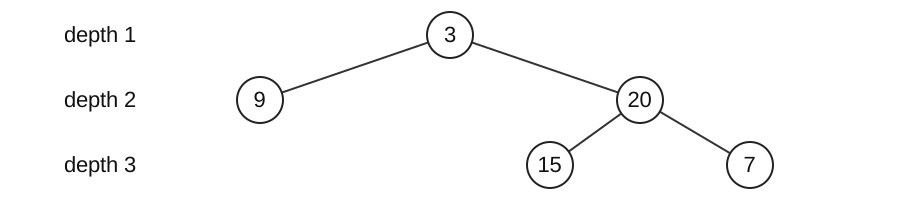
| 3 | 1 (from 9) | 2 (from 20) | 3 |
Each call has its own local root variable. A parent remains active while waiting for child results. Every node is visited once, giving O(n) time, but up to h calls wait simultaneously, giving O(h) auxiliary space.
Python limits recursion depth. The following implementation retains depth information in an explicit stack to handle long chains.
LeetCode 104: Maximum Depth of Binary Tree · Easy
Return the maximum root-to-leaf path length measured in nodes.
0..10^4 nodes; values -100..100.
Predict before implementing
Store (node, depth) on a stack, starting at depth 1. Update best on every pop and push children at depth+1. A three-node chain and a three-node balanced tree have different depths; draw both.
max_depth(tree([4, 2, 7, None, 3]),)
# 3
In Week 3, linked() builds linked nodes; in Week 4, tree() builds a tree from level-order notation. Both helpers are in structures.py.
Idea and state transitions
104 · Idea and execution trace
LeetCode 104: Maximum Depth of Binary Tree · Easy
Return the maximum root-to-leaf path length measured in nodes.
Depth counts nodes from the root to the current node. Store (node, depth) together so depth need not be reconstructed. Each child is one level deeper; the largest encountered depth is the answer.
Tree: root 3; children 9 and 20; children of 20 are 15 and 7. Stack top is on the right.
| Popped (value,depth) | Stack after child pushes | best |
|---|---|---|
| (3,1) | [(9,2),(20,2)] | 1 |
| (20,2) | [(9,2),(15,3),(7,3)] | 2 |
| (7,3) | [(9,2),(15,3)] | 3 |
| (15,3) | [(9,2)] | 3 |
| (9,2) | [] | 3 |
104 · Why it works; time and memory
Structural induction proves the recurrence. The explicit stack carries the true root depth to every node and records its maximum.
Every tree node is pushed once by its unique parent. There are n pushes and pops, plus two child checks per node, so time is O(n). The two if statements do not add another size-dependent loop.
For height h, at most one pending sibling branch per level accumulates, giving O(h) stack space, at worst O(n). A one-child chain keeps only one pending entry in this iterative version, whereas recursive calls accumulate to depth h.
Python recursion depth may be below a 10^4-node chain; distinguish the small-tree recursive demonstration from the full-contract iterative version.
root=[4,2,7,None,3] → 3
Implement and execute
from collections import deque

def max_depth(root):
    """Explicit stack supports skew trees within the official size limit."""
    if root is None:
        return 0
    stack, best = [(root, 1)], 0
    while stack:
        node, depth = stack.pop()
        best = max(best, depth)
        if node.left:
            stack.append((node.left, depth + 1))
        if node.right:
            stack.append((node.right, depth + 1))
    return best
python trace_lab.py --case max_depth
Compare the trace return value with your prediction. Make the input change proposed above, find the first line where the state differs, and explain its effect on the answer.
LeetCode 102: Binary Tree Level Order Traversal · Medium
Return tree values grouped by depth, left to right.
0..2000 nodes; values -1000..1000.
Predict before implementing
Use deque and freeze the queue length at the start of each level. Newly appended children belong to the next level. Predict queues [4], [2,7], [3] before execution.
level_order(tree([4, 2, 7, None, 3]),)
# [[4], [2, 7], [3]]
In Week 3, linked() builds linked nodes; in Week 4, tree() builds a tree from level-order notation. Both helpers are in structures.py.
Idea and state transitions
102 · Idea and execution trace
LeetCode 102: Binary Tree Level Order Traversal · Medium
Return tree values grouped by depth, left to right.
A first-in, first-out queue visits nodes by depth. Freeze its length at the start of each level so children appended during that level remain for the next one.
Use the preceding 3–9–20–15–7 tree. The queue’s left end is removed next.
| Queue at level start | Frozen length | Current level | Next queue |
|---|---|---|---|
| [3] | 1 | [3] | [9,20] |
| [9,20] | 2 | [9,20] | [15,7] |
| [15,7] | 2 | [15,7] | [] |
The result is [[3],[9,20],[15,7]].
At the second level, queue=[9,20] fixes the loop count at two. Removing 9 leaves [20]; removing 20 and adding its children leaves [15,7]. Although the queue is nonempty, those two iterations are complete, so level=[9,20] is stored before the next level starts.
102 · Why it works; time and memory
At each outer-loop entry the queue contains one level. Processing its initial size leaves only the next level; left-first insertion preserves order.
The outer loop counts levels, but the inner-loop counts sum to exactly n nodes across all levels. Constant-time queue insertion and removal give O(n) time. Using list.pop(0) on wide levels can instead cause O() total shifting.
If maximum level width is w, the queue holds the rest of one level plus part of the next, still O(w) entries. Queue workspace is O(w); returned level values occupy O(n). Including output, extra space is O(n).
list.pop(0) shifts the remaining entries; repeated use can reach O() on wide trees.
root=[4,2,7,None,3] → [[4],[2,7],[3]]
Implement and execute
from collections import deque

def level_order(root):
    if root is None:
        return []
    queue, result = deque([root]), []
    while queue:
        level = []
        for _ in range(len(queue)):
            node = queue.popleft()
            level.append(node.val)
            if node.left:
                queue.append(node.left)
            if node.right:
                queue.append(node.right)
        result.append(level)
    return result
python trace_lab.py --case level_order
Compare the trace return value with your prediction. Make the input change proposed above, find the first line where the state differs, and explain its effect on the answer.
LeetCode 98: Validate Binary Search Tree · Medium
Decide whether all descendants satisfy strict BST ordering.
1..10^4 nodes; signed 32-bit values; equal keys violate ordering.
Predict before implementing
Carry strict lower and upper bounds from ancestors. Node 6 is less than parent 10 but lies in the right subtree of 8, so it violates (8,10). Replace 6 by 9 and predict True.
valid_bst(tree([8, 3, 10, None, None, 6, 12]),)
# False
In Week 3, linked() builds linked nodes; in Week 4, tree() builds a tree from level-order notation. Both helpers are in structures.py.
Idea and state transitions
98 · Idea and execution trace
LeetCode 98: Validate Binary Search Tree · Medium
Decide whether all descendants satisfy strict BST ordering.
Comparing only parent and child misses constraints inherited from ancestors. With root 5, every value in the right subtree must exceed 5. Pass an allowed interval (lower, upper) to summarize all ancestral constraints.
Check a tree with root 5, right child 8, and 8’s left child 4.
| Node value | Allowed interval | Test result |
|---|---|---|
| 5 | (-∞,∞) | Pass |
| 8 | (5,∞) | Pass |
| 4 | (5,8) | 5 < 4 is false → False |
Although 4 is smaller than its parent 8, it cannot lie to the right of root 5.
98 · Why it works; time and memory
The interval is the intersection of all ancestor constraints. Tightening it preserves that meaning; any violation invalidates the whole tree.
A valid tree requires processing n nodes and a fixed number of empty-child entries per node. Two bound comparisons and stack operations per node give O(n) time. Early failure can shorten a run but does not change the worst-case bound.
Each stack entry contains a node reference and two bounds, a constant-size record. At most O(h) entries remain pending, so auxiliary space is O(h), at worst O(n). Adding bounds does not make each record grow with the tree.
The example’s 6 is below its parent 10 but lies right of root 8; parent-only checks miss it.
root=[8,3,10,None,None,6,12] → False
Implement and execute
from collections import deque

def valid_bst(root):
    stack = [(root, float("-inf"), float("inf"))]
    while stack:
        node, lower, upper = stack.pop()
        if node is None:
            continue
        if not lower < node.val < upper:
            return False
        stack.append((node.right, node.val, upper))
        stack.append((node.left, lower, node.val))
    return True
python trace_lab.py --case valid_bst
Compare the trace return value with your prediction. Make the input change proposed above, find the first line where the state differs, and explain its effect on the answer.
LeetCode 230: Kth Smallest Element in a BST · Medium
Return the kth smallest BST value.
1 <= k <= n <= 10^4; values 0..10^4.
Predict before implementing
Follow left links while stacking nodes. Pop to visit the next smallest value, decrease k, then enter the right subtree. Record visits 1,2,3,4. Compare k=1 with k=7.
kth_smallest(tree([4, 2, 6, 1, 3, 5, 7]), 4)
# 4
In Week 3, linked() builds linked nodes; in Week 4, tree() builds a tree from level-order notation. Both helpers are in structures.py.
Idea and state transitions
230 · Idea and execution trace
LeetCode 230: Kth Smallest Element in a BST · Medium
Return the kth smallest BST value.
In a BST, visiting the left subtree, node, then right subtree yields increasing values. Stop at the kth visit rather than collecting and sorting every value.
Root 3, left child 1 with right child 2, and right child 4. k=2; stack top is on the right.
| Action | stack | Remaining k | Visited values |
|---|---|---|---|
| Push left path 3,1 | [3,1] | 2 | None |
| Pop 1; move to its right, 2 | [3] | 1 | 1 |
| Push 2 | [3,2] | 1 | 1 |
| Pop 2 | [3] | 0 | 1,2 → return 2 |
230 · Why it works; time and memory
Every left value is smaller and every right value larger. Induction makes inorder sorted, so the kth visit gives the answer.
The initial left descent pushes at most h nodes. The algorithm pops k nodes; total pushes can be charged to popped nodes plus the at most h entries still pending. Time is O(h+k), becoming O(n) for k=n.
At most h ancestors occupy the stack, so auxiliary space is O(h). No full traversal array is stored. A balanced tree has h=O(log n), but a skew tree can have h=O(n).
If materializing inorder, index at k-1. That alternative uses O(n) auxiliary space and time.
root=[5,2,8,1,3], k=3 → 3
Implement and execute
from collections import deque

def kth_smallest(root, k):
    stack, node = [], root
    while stack or node:
        while node:
            stack.append(node)
            node = node.left
        node = stack.pop()
        k -= 1
        if k == 0:
            return node.val
        node = node.right
    raise ValueError("k exceeds tree size")
python trace_lab.py --case kth_smallest
Compare the trace return value with your prediction. Make the input change proposed above, find the first line where the state differs, and explain its effect on the answer.
Lab report
Include the small-input state table, completed code, your own boundary input and expected result, and verification results. Explain time by total operation counts and space by simultaneously live state. Include any input copying or sorting costs.